Sociology Optional Module Course for UPSC A Practical Guide - Delhi - Delhi ID1665286
Offering about 2 months ago - Other educations - Delhi0

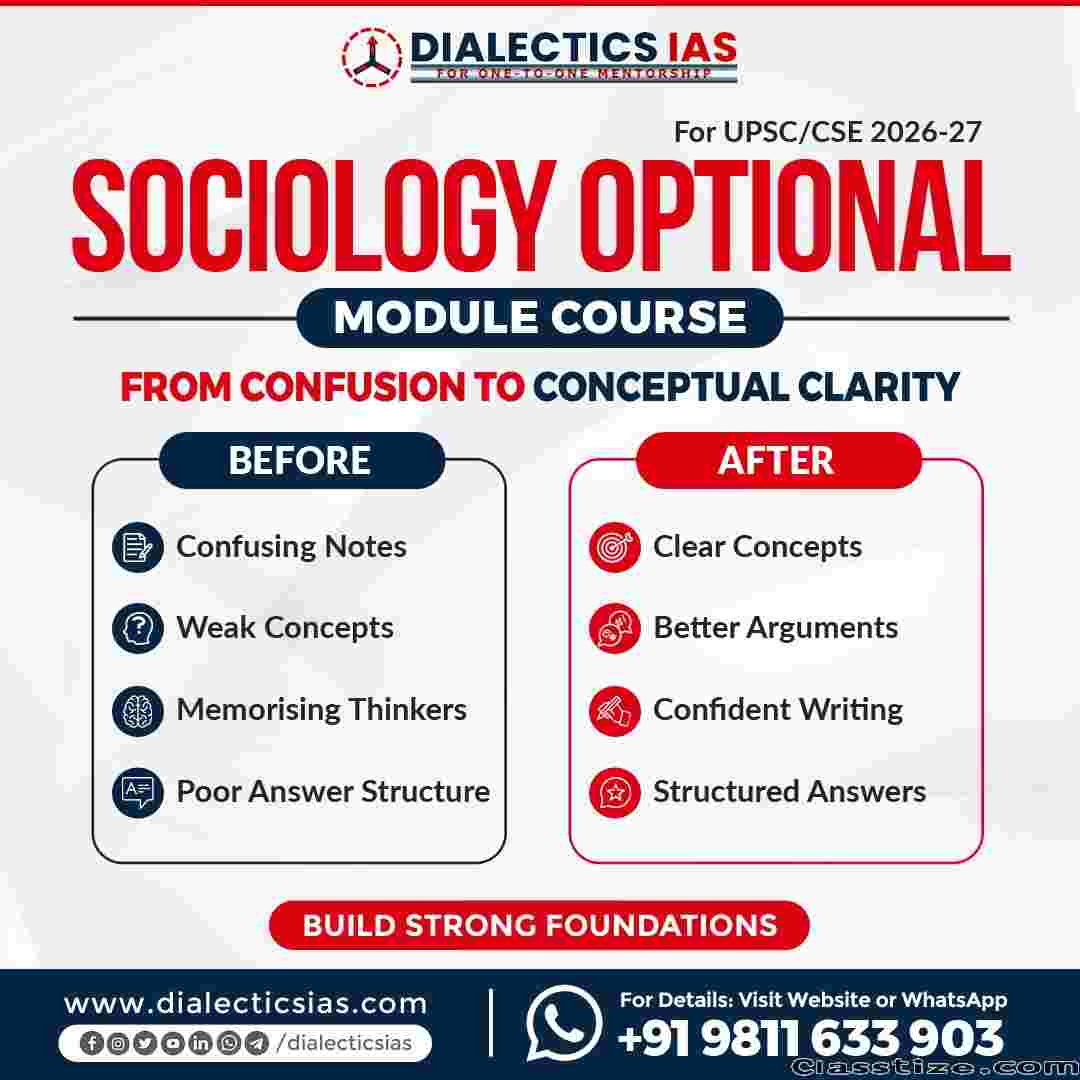
Details
If you've started researching Sociology Optional online coaching, you've probably noticed the same problem every serious aspirant runs into: too many providers, too many claims, and almost no clarity on what an "online module course" actually delivers. This piece breaks that down — plainly, without the sales pitch.
Sociology Optional remains one of the more consistently chosen humanities optionals for UPSC CSE, largely because Paper I rewards conceptual thinking over rote memorisation. But Paper I is also where most candidates lose momentum — six major thinkers, a science-vs-interpretivism debate, and a research methods unit, all compressed into one paper worth 250 marks.
https://dialecticsias.com/sociology-optional -online-module-course-for-upsc/
That's the gap a Sociology Optional Paper I foundation course is meant to fill.
What Exactly is a "Module Course" in Sociology Optional?
Unlike a full-length foundation programme covering both papers over several months, a module course narrows in on one segment — typically Paper I — and teaches it in depth. Think of it less as a shortcut and more as a magnifying glass.
A properly built Sociology Optional Paper I online module batch usually includes:
-
Structured lectures covering the discipline, Sociology as Science, and Research Methods
-
Dedicated coverage of the six core thinkers
-
Doubt-resolution sessions
-
At least one form of evaluated testing to check whether concepts are converting into answers
This format has grown popular among a specific set of aspirants — repeaters, working professionals, and those from technical backgrounds — who need targeted help rather than a six-month commitment.
Why UPSC Aspirants Are Actively Searching for This Format
A few real patterns show up again and again in how candidates search for this kind of course:
-
"Top Sociology online programs for UPSC 2027" — aspirants comparing multiple providers before committing
-
"Sociology Optional module course for UPSC CSE" — candidates who already know they don't want a full-length programme
-
"Live Sociology Optional foundation course" — a growing preference for real-time interaction over pre-recorded content
-
"Sociology Optional Paper I conceptual clarity course" — candidates burned by note-heavy preparation with no depth
Neither option is objectively superior — the right choice depends entirely on where you currently stand in your preparation.
The Real Differentiator: Who Reads Your Answer
Here's something most course comparisons skip entirely: lecture count matters far less than who evaluates your answers.
A large share of Sociology Optional aspirants plateau not because they don't understand Marx or Durkheim, but because their answers are checked by someone disconnected from how they were taught. Generic ticks and a number at the top of the page don't tell you why an answer didn't work.
This is where a genuinely professor-led Sociology Optional online course earns its place. When the same person teaching a concept also evaluates how you've applied it, the feedback loop actually closes. That distinction matters more for your final score than almost anything else on a syllabus checklist.
Who Should Actually Consider a Module-Based Course?
A focused Paper I module tends to work well for:
-
Aspirants who already have some grounding and want to sharpen thinkers and research methods specifically
-
Engineering, commerce, or science graduates encountering sociological theory for the first time
-
Working professionals who can't commit to a long, fixed-schedule programme
-
Repeat candidates whose theoretical base is fine but whose answer-writing needs correction
-
Self-study aspirants who want evaluated feedback without paying for a full syllabus they've already covered
It's a weaker fit if you're starting from zero on both papers and prefer one continuous, linear programme.
What a Genuinely Well-Structured Module Should Include
Before enrolling anywhere, it's worth checking a module course against a simple list:
-
Does it cover Sociology – The Discipline, Sociology as Science, Research Methods, and all six thinkers (Marx, Durkheim, Weber, Parsons, Merton, Mead)?
-
Is there a mechanism for doubt-clearing, not just one-way lecture delivery?
-
Are there evaluated tests, or is testing left entirely to the candidate?
-
Is the batch size small enough that feedback can actually be personal?
-
Is admission preceded by any kind of counselling or preparation-level check, or is it a straightforward transaction?
Dialectics IAS runs its Sociology Optional Paper I Online Course along exactly these lines — around 30 structured lectures, two doubt-clearing sessions, and two sectional tests of 250 marks each, with every script read and discussed by the same professor who delivers the lectures.
Admission follows a short counselling conversation rather than a direct purchase, and the batch is capped at 20 seats to keep that evaluation genuinely personal.
You can look at the course structure here: Sociology Optional Paper I Online Course →
A Word on Model Answers
One habit worth breaking early: collecting and reproducing "model answers" verbatim. UPSC evaluators read hundreds of scripts on identical questions — an answer that reads like fifty others rarely stands out, however polished it looks.
What actually earns marks is a clear, original line of argument, built from your own understanding of a thinker, applied precisely to what the question is asking.
This is arguably the single biggest reason conceptual clarity courses outperform note-heavy, memorisation-driven preparation over the long run.
-
A module course focuses on Paper I specifically, not the entire Sociology Optional syllabus
-
Evaluation quality — who reads your answer — matters more than the number of lectures
-
Original argument beats memorised model answers in UPSC's actual evaluation logic
-
Module courses suit repeaters, professionals, and technical-background aspirants especially well
-
A short counselling conversation before enrolment is a good sign, not a formality to skip
Where to Go From Here
If you're still comparing formats, a free conversation is usually more useful than reading another ten comparison articles. Dialectics IAS offers counselling before admission — no pressure, just an honest read on where your Paper I preparation actually stands.
Request Counselling
Prefer to start with free material first? Notes, PYQs, and thinker-wise reading lists are available here: Explore Free Resources Or, for a specific question about your own preparation: Message Us on WhatsApp
If any of these sound like your own search history, you're not alone — this is one of the more common decision points in Sociology Optional preparation right now.
When you call, don't forget to mention that you found this ad on CLASSTIZE.COMPrice 0 I am Offering Category is Education Type is Other educations Ad placed in Delhi Phone no: 9811633903 Address: Bada Bazar Marg, Old Rajinder Nagar, New Delhi 110060 Email Address Visit Website